
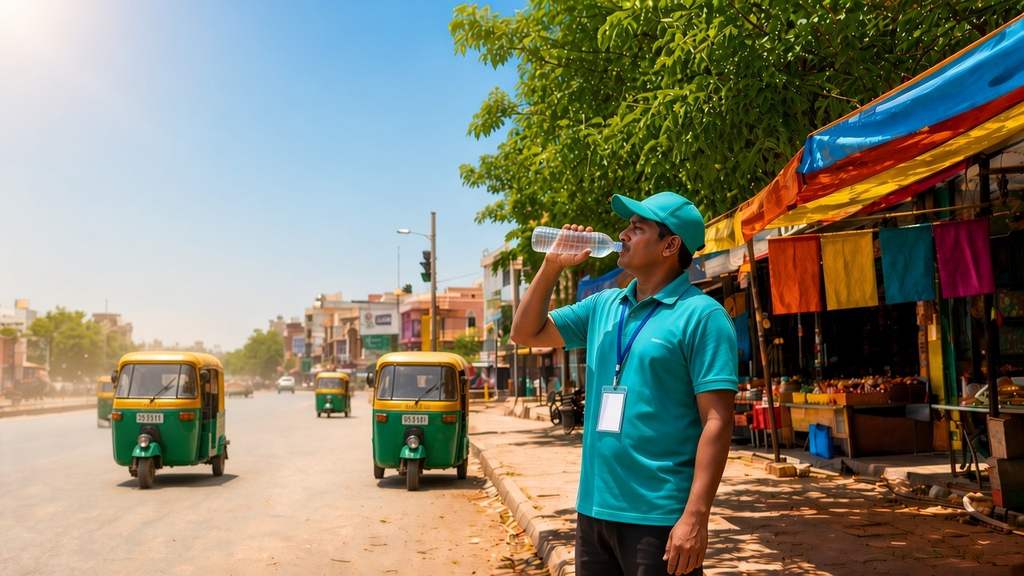

Heat is already costing Indian companies working hours, output and health. This paper shows how heat reaches the P&L, what disclosure frameworks (IFRS S2, TCFD, BRSR Core) expect, a simple metric set for hot hours and heat-illness cases, and lessons from cricket's heat policies.
1. Executive summary
Most of us still treat heat as a weather story or a welfare issue. For Indian companies with factories, sites, warehouses, fleets or field teams, it is also a cost line. It is already large and growing, and climate disclosures now expect companies to report it. Here is what the evidence shows.
- The loss is already large. Heat exposure in India cost an estimated 247 billion potential labour hours in 2024, a record 419 hours per person and 124% more than in 1990–1999 [2]. The ILO projects that India will lose 5.8% of all working hours to heat stress in 2030, up from 4.3% in 1995 [3].
- Europe shows the bill even in a cooler climate. Allianz Research estimates that the 2026 summer heatwaves cost 30 European economies about €113 billion of output, around 0.46% of their combined GDP, mostly through slower work, longer breaks and missed work [31].
- It reaches the P&L through several channels at once: lower output per hour, more absence, heat illness and heat-related accidents, higher cooling and power demand, stressed equipment, and disrupted supply chains and informal labour. Heat also cuts children's learning and closes schools, affecting employees' families and the future workforce. In a national panel of Indian factories, annual plant output fell by about 2% per degree Celsius [5].
- Disclosure frameworks already cover it. IFRS S2 names heatwaves and effects on "employee health and safety" in its definition of physical risk [23]. TCFD lists workforce health, safety and absenteeism as a physical-risk impact [22]. BRSR Core requires third-party assessment or assurance of safety-incident data, including for contract workers [24]. Heat illness is best counted there as work-related ill health, not as an injury (Section 5) [43–50].
- Indian companies are acting on heat, but not yet putting a number on what it costs them. Not one of the Indian corporate disclosures cited in this paper quantifies heat's impact on the company's own workforce in hours, productivity or rupee cost. Vedanta Aluminium, Hindustan Zinc and Mahindra come closest [10–12]. A Singapore transport group shows it can be done with off-the-shelf data [14].
- A small metric set and a practical playbook close the gap. Count hot days and WBGT-hours per site, convert them to working hours lost with published response functions, price the hours, and track heat-illness cases and contract-worker coverage. Companies certified to ISO 45001 can run all of this inside their existing occupational health and safety system (Sections 5 and 6).
- Cricket got there before most companies did. Cricket's heat research and policies show the value of WBGT triggers, tiered stop-play rules, ventilated kit, acclimatisation and special care for the young. A batsman's day at the crease produces as much heat as running at about 8 km/h [56]. In Section 8, I take eight lessons from cricket and turn each one into something a company can do.
2. Why heat is a material business risk in India
The hazard is rising
The India Meteorological Department (IMD) treats a heatwave as possible when a plains station reaches at least 40 °C (30 °C in hilly regions, 37 °C at coastal stations), and declares one on departure from normal (4.5–6.4 °C) or an actual maximum of 45 °C or more [1]. In 2024, people in India were exposed to 19.8 heatwave days each on average, 6.6 of which would not have been expected without climate change [2]. They also faced 366 more hours than in 1990–1999 in which moderate outdoor activity carried a moderate or higher risk of heat stress, a record high [2]. Companies' own projections point the same way. Vedanta Aluminium projects 14–17 more days a year above 40 °C at its BALCO smelter by 2050 (SSP2-4.5 to SSP5-8.5), against a 2014 baseline [10]. And next year could be worse. In a sensitivity scenario, Allianz Research estimates that a very strong El Niño could cost India about US$50 billion (0.30% of GDP) in 2027 [31].
Temperature alone understates the risk: WBGT basics
Humidity, sun and wind change how much heat the body can shed. Occupational health therefore uses the wet bulb globe temperature (WBGT), which combines air temperature, humidity, air movement and radiant heat and was designed for assessing work activity [3]. The ILO notes that at a WBGT of 33–34 °C a worker doing moderately intense work loses 50% of his or her work capacity [3]. In gridded labour-capacity data, humid coastal Chennai shows a higher baseline loss for moderate indoor work (4.15% a year) than Delhi (3.64%) [26]. A site plan built only on air temperature can miss the risk.
Who is most exposed
Exposure is highest where work is heavy, outdoors or in hot indoor spaces without cooling. ILO estimates for India (Figure 1) show agriculture and construction losing the most hours, with industry close behind by 2030 [3]. The Lancet Countdown attributes 66% of India's 2024 heat-related labour losses to agriculture and 20% to construction [2]. As many as 90% of workers in India work informally [3]. For a company, that means much of the exposed workforce in its value chain sits outside its payroll and its safety systems. In the OECD's informality database (developing and emerging economies), informal workers lost 2.4% of their working hours to heat in 2025, against 1.4% for formal workers; India's safety rules, though they recognise unorganised workers, are in practice designed for establishments with 10 or more workers [57].

3. How heat hits corporates
Labour productivity and hours lost. Heat slows work and forces longer breaks. The Lancet Countdown values India's potential income lost to reduced labour capacity at US$194 billion in 2024 [2]. In Indian factories (weaving, garments, steel), worker output falls on hot days, and a 15-year national panel of plants predicts annual output to fall by 2.1% if every day warms by 1 °C [5]. McKinsey estimated that effective outdoor working hours lost in India could rise by about 15% by 2030, putting about 2.5–4.5% of GDP (US$150–250 billion) at risk [6].
Health: heat illness, and accidents where heat plays a part. Heat causes cramps, exhaustion and heat stroke, a medical emergency [21, 50]. These are illnesses, best recorded as work-related ill health rather than injuries (Section 5 box) [45, 48]. Heat also raises accident risk. Globally, the ILO estimates that excessive heat causes 22.85 million occupational injuries and 18,970 deaths a year, and that over time heat stress can lead to serious heart, lung and kidney problems [4]. In Asia and the Pacific, 74.7% of the workforce is exposed to excessive heat [4]. Prevention works: Ahmedabad's Heat Action Plan is estimated to have avoided 2,380 deaths in the period after it was introduced [19].
Absenteeism and attrition. In the Indian factory study, absenteeism rose with same-day and previous-week temperatures. Climate control at work removed the productivity loss but not the absenteeism, presumably because workers stay exposed at home and outside [5]. We found no published Indian dataset linking heat to attrition; companies should track it rather than assume it is zero.
Students, families and the future workforce. Children are more vulnerable to heat than adults: infants and young children are less able to regulate their body temperature [37]. Heat also cuts learning. In a US study of 10 million students who retook the PSAT, without air conditioning each 1 °F hotter school year reduced that year's learning by 1% [34]. In India, across more than 4.5 million Annual Status of Education Report (ASER) tests, ten extra days above 29 °C in a year (compared with days at 15–17 °C) lowered children's maths and reading scores the following year by 0.03 and 0.02 standard deviations, partly through lost farm income; the rural job guarantee (NREGA) weakened the link [35]. UNICEF estimates that heatwaves disrupted schooling for about 171 million students worldwide in 2024, including about 54.8 million in India (a partial, state-level count), and notes that heat and poor hydration hinder children's ability to focus and retain information [36]. WHO notes that athletes are susceptible to exertional heat stress [38]. For most companies the closest link is their own employees, whose children's schools close or change timings in the heat. It also matters to education, edtech and sports businesses, to school-focused CSR, and to the skills of the future workforce. The NCB ACE case study (Section 7) looks at it through student cricket coaching.
Operations and assets. Cooling loads and power demand rise with heat. India's cooling demand is projected to grow to around eight times its 2017–18 level by 2037–38, and space cooling alone to account for 45% of peak electricity demand in 2050 [7]. Equipment suffers too: Vedanta Aluminium reports that prolonged heat affects equipment and lubricant performance and raises operating costs [10], and Singtel's modelling found that, without adaptation, heat-related failure could occur once every 1.4 years at its Singapore telephone exchanges by 2100 [9].
Supply chain and informal workforce. One global model attributes 12–43% of projected heat-related economic losses by 2060 to indirect effects cascading through supply chains [8]. For informal workers the hit is immediate: SEWA reported that extreme heat had cut the working hours of nearly all its women members, forcing them to stay home or take long breaks between 1 pm and 4 pm [18].
Regulation and disclosure. IFRS S2 defines physical risk to include heatwaves and "extreme temperature changes affecting the entity's premises, operations, supply chains, transportation needs and employee health and safety" [23]. TCFD lists "reduced revenue and higher costs from negative impacts on workforce (e.g., health, safety, absenteeism)" [22]. In India, BRSR Core covers safety-related incidents (lost-time injury frequency rate and fatalities) for employees and workers, including the contract workforce, and requires third-party assessment or assurance, which applies to the top 1,000 listed entities from FY2026–27; its value-chain disclosures are voluntary for the top 250 from FY2025–26 [24]. CEEW notes that Indian labour law has no legally binding, heat-specific occupational safety standard, and that BRSR does not uniformly require quantified physical-risk indicators [25]. BRSR's Principle 3 table of "safety related incidents" covers work-related ill health as well as injury but does not identify heat illness separately, so heat stays largely invisible in Indian disclosures (Section 5 box) [43, 44].
4. What leading companies are doing, and the gap
India
- Vedanta Aluminium tracks the annual count of days above 40 °C and maximum temperatures as a key risk indicator, with site projections to 2100. It has shifted schedules, built rest sheds with coolers, placed water stations every 200–300 m and issued heat-stress SOPs, and plans WBGT weather stations at all sites, heat-stress cover in insurance and business-partner contracts, and automation of the hottest processes [10].
- Hindustan Zinc names the right impact metric, "relative change in labour productivity due to heat stress" under NGFS scenarios for Rajasthan and Uttarakhand, and rates the workforce impact as high, but shows the results only as arrows, with no values [11].
- Mahindra Group has the most developed governance: heat action plans written into corporate Key Result Areas, SOPs based on site self-audits, and pilots of evaporative cooling jackets, vehicle canopy insulation and cooling shelters in Jaipur, Nagpur and Rudrapur [12]. Its whitepaper with Deloitte sets out a phased, four-pillar approach with board-level ownership (Section 6) [13].
- Others report actions rather than metrics: Tata Steel schedules work to limit direct-sun exposure between 12 noon and 3 pm, and L&T extends lunch breaks and keeps a doctor available full time [28]. ITC reports that a personal cooling vest for construction workers lowered temperature by about 6 °C in laboratory tests [29].
- Bharti Airtel and Nxtra by Airtel report heat measures mainly as awareness and site practice. Nxtra's FY25 sustainability report lists "heat stress prevention through water stations, ORS distribution, and tailored training" [51]; its EHS programme made Heat Stress the April 2025 safety "Topic of the Month" [53]; and its FY2025-26 report names "heat stress management" among occupational-health measures, with seasonal risks addressed "through targeted advisories, awareness campaigns, and preventive healthcare measures" [52]. During the 2024 heatwave, a senior Airtel executive told ETTelecom that Airtel had set up special teams to track field staff's health, issue heat-stroke advisories (including reminders to stay hydrated) and offer medical support [54]. Airtel's 2025-26 annual report notes that climate risks "pose health and safety risks to personnel" and sets temperature-related site design criteria, such as reflective roofs and external shading [55]. Both run internal campaigns to beat the heat.
- SEWA's parametric heat insurance is the clearest Indian case of a heat-day metric tied to money: it pays when a set number of consecutive days exceed a threshold temperature, with payouts based on daily income [17]. In 2024, 92% of the 50,000 women enrolled received payments [17].
Global
- ComfortDelGro (Singapore) quantified heat-stress productivity loss from Climate Impact Explorer labour-productivity data and its own labour costs. Labour productivity is its largest physical risk: 43–56% of total additional financial impact in a >3 °C scenario, reaching 55.5% by 2050 [14]. Its subsidiary SBS Transit projects a 15% rise in annual operating costs from heat-related productivity loss by 2050 in the same scenario [15].
- Even large global reporters find it hard. Olam Agri states that quantifying the effect of extreme temperatures on employee health and productivity "is still under consideration" [16].
Listening to field staff led to a real change: In our interactions at a large company with an extensive outdoor field workforce, field engineers described working through intense heatwaves in what was then a synthetic black uniform. Some staff developed extensive skin rashes and other heat-stress-induced health problems, and these became reasons for voluntary attrition. The observations were shared and acted on internally: the uniform was changed to a cooler, cotton-based fabric and heat shelters were put up.
5. Measuring it: a simple metric framework
Here are six metrics any multi-site company can start with in one reporting cycle. The first two describe the hazard, the next two its effect on working hours and money, and the last two the health outcome and the company's response. No source we found publishes day-count bands (what counts as "many" hot days), so each company must set and disclose its own.
| Metric (what it shows) | How to calculate / data | Published reference | ISO 45001 clause |
|---|---|---|---|
| 1. Hot days per site (hazard frequency) | Days a year with Tmax ≥ 40 °C, or heat-index days; IMD data or gridded datasets | IMD heatwave threshold 40 °C plains [1]; Vedanta KRI [10] | 4.1 (climate change), 6.1.2 hazard identification |
| 2. WBGT-hours above limit (hazard at the workplace) | Hours with WBGT above the limit for the work intensity; on-site meters, logged hourly | Singapore MOM: mandatory rest from WBGT 32 °C for heavy work [20] | 9.1 monitoring and measurement |
| 3. % working hours lost (productivity) | WBGT-based response functions by work intensity (200/300/400 W), indoor or outdoor; ILO or Lancet functions, or gridded data [3, 26] | ILO: 50% capacity lost at 33–34 °C WBGT, moderate work [3] | 6.1.2 assessment of risks |
| 4. Cost of lost hours (financial) | Hours lost × loaded hourly labour cost (headcount × scheduled hours × % lost); show as ₹ and % of wage bill or EBITDA | ComfortDelGro method [14] | 6.1.2 risks and opportunities; 9.3 management review |
| 5. Heat-illness cases (health outcome) | Heat illness (first aid, recordable, lost time, high consequence) and deaths, coded as work-related ill health with heat as the cause; employees and contract workers; footnoted in the BRSR Principle 3 table | GRI 403-10 [45]; OSHA 29 CFR 1904 [48, 49]; BRSR P3 Q11 [43, 44] | 10.2 incident investigation; 9.1 |
| 6. Response coverage (resilience) | % of exposed workers (employees + contract) covered by a site heat action plan with WBGT-triggered work-rest rules | NDMA heat action plan guidance [21] | 8.1.2 controls; 8.1.4 contractors; 5.4 consultation |
6. Building resilience: a practical playbook
Run it through the ISO 45001 system
If your occupational health and safety (OH&S) management system is certified to ISO 45001:2018, you already have a system to manage heat in. The standard is built on the Plan-Do-Check-Act cycle [39], and heat is simply another OH&S hazard to run through it. Since the 2024 climate amendment, clause 4.1 requires an organisation to determine whether climate change is a relevant issue, and clause 4.2 notes that interested parties can have climate-related requirements [40].
Plan: identify heat as a hazard and assess the risk by task, site and season (6.1.2), consulting workers and contractor representatives (5.4).
Do: apply the hierarchy of controls (8.1.2): eliminate or automate hot tasks, then engineering controls (cooling, shade, ventilation), then administrative controls (work-rest cycles, timing, training), with PPE last, since PPE that is too hot or heavy is less likely to be worn [42]. Plan the emergency response to heat stroke (8.2) and set heat rules for contractors through procurement (8.1.4).
Check: monitor WBGT and heat-illness cases (9.1).
Act: investigate heat-illness cases, heat-related accidents and near misses, and correct the controls (10.2). ISO 14090 (adaptation principles) and ISO 14091 (climate vulnerability, impact and risk assessment) can support the company-wide view [41]. The table below maps each measure to its clause.
Each measure below comes from published guidance or company practice. Start with governance and measurement, so that the money goes where the hours are actually being lost. Section 8 adds lessons from sport.
| Measure | What to do | ISO 45001 |
|---|---|---|
| Governance | Give heat a named board-level owner and put site heat plans into management KRAs, as Mahindra has done [12]. Review heat risk at least once a year in the enterprise risk process [9]. | 5.1, 5.3; 4.1 |
| Risk assessment | Screen all sites, then model the most exposed and critical ones in detail [9]. Map work by intensity (200/300/400 W) and indoor or outdoor exposure, including contract labour. Consult workers and contractor representatives on the findings and heat rules. | 6.1.2; 5.4 |
| Heat action plans and early warning | Link site actions to IMD's colour-coded alerts (yellow, orange, red) [21]. Ahmedabad's plan sets alert levels at 41.1–43 °C, 43.1–44.9 °C and 45 °C or more, and asks employers to provide water and consider longer afternoon breaks or alternative working hours [19]. Plan first aid and emergency response for suspected heat stroke, a medical emergency [21]. | 8.1, 8.2 |
| Work-rest cycles and shifting hours | Move strenuous work to cooler hours and add rest breaks [21, 3]. Benchmarks: Singapore requires at least 10 minutes' rest an hour for heavy work at WBGT 32 °C and 15 minutes at 33 °C [20]; Tata Steel limits direct-sun work from 12 noon to 3 pm [28]. | 8.1.2 (admin.) |
| Cooling, shade and hydration | Provide cool drinking water near the work, shade and rest shelters [21]. A Chandrapur coal-mine advisory sets rest shelters below 25 °C [30]. Vedanta places water stations every 200–300 m [10]. Indoors, use ventilation, cool or green roofs and shading [3]. | 8.1.2 (engineering) |
| PPE and monitoring | Use more breathable protective clothing and breaks to remove heavy PPE [3]. Pilot cooling vests [12, 29]. Install WBGT meters and log readings hourly in the hot season [20, 10]. Train staff and first-aiders, use a buddy system, and give extra attention to pregnant workers and those with medical conditions [3, 21]. | 8.1.2 (PPE); 9.1; 7.2 |
| Infrastructure and design | Size cooling for future peaks and make power supply resilient with on-site generation and storage [9]. Automate or mechanise the hottest, heaviest tasks [10, 3]. | 8.1.2 (eliminate); 8.1.3 |
| Insurance and parametric cover | Check that insurance covers heat-related illness for employees and partners [10]. Consider parametric income protection for low-wage and informal workers, on the SEWA model [17, 57]. | Outside ISO 45001 |
| Supply chain and contractors | Write heat clauses (water, shade, timings, incident reporting) into contractor and business-partner contracts [10]. Use BRSR Core value-chain reporting (voluntary for the top 250 listed entities from FY2025–26) to collect heat-illness cases from key partners [24]. | 8.1.4; 5.4 |
| Disclosure and targets | Report metrics 1–6 in BRSR narrative and IFRS S2/TCFD physical-risk sections [22–24], with heat illness footnoted as work-related ill health in the BRSR Principle 3 table (Section 5 box) [43, 44]. Set targets on outcomes (hours lost, heat-illness cases) as well as inputs (shelters, vests). | 6.2, 9.3, 10.2 |
Learnings from the Mahindra–Deloitte heat whitepaper
Mahindra Group and Deloitte South Asia's whitepaper, Corporate heat adaptation and mitigation strategies [13], was developed with a working group of industry, policy and research stakeholders. We found it a useful Indian corporate reference to read alongside the measures above.
7. Case study: NCB ACE cricket academies (Delhi)
A Delhi cricket academy in summer faces the corporate problem on a small scale. The work is outdoors, the schedules are fixed, coaching staff are paid by the hour or session, and revenue depends on attendance. It also links to the student evidence in Section 3: the trainees are students in age-group batches whose attendance, health and safety depend on how heat is managed. With NCB ACE Sports, we looked at its two cricket training academies, at Patel Nagar and Mayur Vihar in Delhi. The box reports what the head coach told us.
Companies are in the same position. Many already do sensible things in the heat because experience tells them to. A simple heat threshold and a record of heat-illness symptoms are what let them measure and report it (Section 5). Section 8 sets the case against the wider cricket research.
8. Lessons from sport: what cricket's heat playbook means for corporates
Cricket is a useful comparison for Indian companies: it is played outdoors through the hottest months, in protective clothing, on fixed schedules, with revenue riding on the result. Hit for Six, a BASIS (British Association for Sustainable Sport) report combining climate science from the Priestley International Centre for Climate with heat physiology from the University of Portsmouth's Extreme Environments Laboratory, sets out how heat affects players, officials, spectators and the game [56]. We turn its findings and the governance responses it records into company actions, and flag where a point is our own inference.
What the cricket research found
Eight lessons and the corporate actions they point to
The table pairs each lesson from cricket with a company action, linked to the Section 5 metrics and the Section 6 ISO 45001 clauses.
| Lesson from sport | What cricket shows | Recommended corporate action |
|---|---|---|
| 1. Measure the body's load, not the air temperature | WBGT ranged from 25.9 °C to 32.0 °C at one air temperature [56]. Sports medicine treats WBGT as the criterion measure of heat stress; the report recommends WBGT monitoring for young players. | Set site triggers on WBGT, not air temperature. Start with the hottest and most humid sites and log readings hourly in the hot season. Count outdoor work in the sun separately (metric 2; ISO 45001 9.1). |
| 2. Agree tiered triggers in advance, and give someone the authority to stop | ACSM uses black, red, yellow and green flags. The report asks national boards for clear thresholds that let officials lengthen drinks breaks, shorten sessions and suspend play [56]. | Write a four-tier site protocol (Table 2) with named stop-work authority at each tier, so no one has to argue for a stop in the moment. Take numeric limits from occupational sources (Section 5), not sport (metrics 2 and 6; 8.1.2, 5.3). |
| 3. Treat clothing and kit as part of the hazard | Pads and helmets restrict sweat evaporation. The report suggests shorts above a WBGT of 25 °C and asks manufacturers to test ventilated helmets, gloves and pads. Lord's relaxed its dress code for members in the 2018 heatwave [56]. | Audit uniforms and PPE for heat. Trial ventilated fabrics and a hot-season variant, add heat performance to PPE and uniform specifications, and relax dress rules in heatwaves. Section 4 gives a first-hand uniform example (8.1.2 PPE; 8.1.4). |
| 4. Screen the person as well as the site | Root's stomach bug, hydration, medication, age and sleep all change heat risk [56]. The same heat affects two players differently. | Add a no-blame fit-to-work check at the start of hot shifts (unwell, vomiting or diarrhoea, fever, new medication), buddy checks, and a named higher-risk list including pregnant workers and those with medical conditions (6.1.2; 7.2). |
| 5. Acclimatise before you load | Acclimatisation is regarded as the most effective way to reduce heat-related risk, and heat exhaustion is mostly seen in people not used to the conditions. The report recommends acclimatisation programmes and longer tours [56]. | Phase in exposure for new joiners, returners from leave, staff transferred from cooler regions, and everyone in the season's first hot week. Include contractors in induction (8.1.2 administrative; 8.1.4). |
| 6. Schedule around the heat and cap exposure spells | Sri Lanka's physical preparation manager schedules conditioning for 7:30 am, as a second session in the midday heat is often unrealistic. Bowlers at Kolkata left the field after four-over spells. The report recommends extra drinks and cooling breaks above a WBGT of 25 °C [56]. | Move hot tasks to cooler hours, rotate people off the hottest tasks, and build drink and cooling breaks into rosters at set tiers. Price the lost throughput so supervisors are not penalised for stopping (metrics 3 and 4; 8.1.2). |
| 7. Protect those least able to say no, and the thinnest sites | Young players tolerate heat less and may feel unable to refuse to play. Unlike at elite level, grassroots cricket often lacks cooling and medical cover [56]. | Give contract and gig workers, new joiners and small supplier or dealer sites the same triggers, water, shade, first-aid cover and a no-penalty right to stop. Write it into contracts and track it (metric 6; 8.1.4, 5.4). |
| 8. Expect judgement and safety-critical tasks to fail first | Vigilance, working memory and dual tasks are more vulnerable to heat than simple tasks [56]. | Our inference: treat heat as a contributing factor in safety-critical work (driving, cranes and forklifts, work at height, control rooms), with tighter triggers and shorter spells, and record heat as a factor in near-miss and incident investigations (6.1.2; 10.2). |
A tiered flag system companies can borrow
Lesson 2 is the most transferable: ACSM's flags link a measured reading to a pre-agreed action. The table shows the flags as reported in Hit for Six [56] beside an illustrative corporate version.
| Flag | ACSM WBGT band | Action in sport (ACSM) | Illustrative corporate action (EaselESG) |
|---|---|---|---|
| Black | WBGT above 28 °C | Cancel, or recommend voluntary withdrawal. | Stop non-essential exposed work. Emergency tasks only, with extra controls and medical cover on hand. |
| Red | 23–28 °C | Advise those at increased risk of heat collapse to withdraw; others slow down. | Mandatory work-rest cycles and rotation. Stand down workers on the higher-risk list. Buddy checks. |
| Yellow | 18–22 °C | Advise those at increased risk to slow down; warn all of the risk. | Extra water and shade breaks. Supervisors check in. Heat-illness signs covered in the toolbox talk. |
| Green | Below 18 °C | Lower risk, but collapse can still occur. | Normal work, with water and shade available and reporting of symptoms still open. |
Cautions before borrowing sport's numbers
The report notes that specific WBGT guidelines for cricket are not widespread, and that its own 25 °C trigger for extra breaks and shorts comes from ACSM guidance for runners, with more work needed for cricket [56]. Athletes also differ from employees: they choose their effort, work for hours rather than shifts, and at elite level have physios and doctors on hand. Companies should copy the structure (measure, tier, pre-authorise, record) and take numeric limits from the occupational sources in this paper: the ILO capacity-loss relationships, Singapore's rest rules at WBGT 32 °C and 33 °C, and the NDMA guidance (Sections 5 and 6).
In practice, heat often comes with other problems: smog, thin crowds and water shortages. Sri Lanka's players wore smog masks during a Test in Delhi in December 2017, and the report recommends air-quality testing at grounds [56]. Delhi and Hyderabad franchise officials blamed heat for low attendance, and drought forced 13 Indian Premier League matches out of Maharashtra in 2016 [56]. Company equivalents are air quality on hot days, footfall and customer comfort in retail, hospitality and real estate, and water availability, which can decide where operations can run. The Mahindra–Deloitte whitepaper records similar effects in India: daily visitors to the Taj Mahal fell from 25,000–30,000 to about 12,000–15,000 in May 2024, and leading Rajasthan hotels saw occupancy of about 20–25% against about 50% a year earlier, with tariffs cut by 75–80% [13].
What this means for the NCB ACE academies
What Hit for Six says. Young players respond differently to heat and tolerate it less well, so extra facilities, guidance or rules should allow for that. At grassroots level, at any age, cooling and prompt medical attention may not be on hand as they are at elite level. Young players may also feel less able to refuse to play in hot or humid conditions, so the report recommends monitoring both conditions (WBGT) and their health [56]. This applies directly to NCB ACE, whose academies train children from the age of 6 onwards.
What the coach described (Section 7). Later summer timings (4–7 pm instead of 3–6 pm), mandatory ORS, chilled water, glucose and a banana for the 6–12 age batches, water breaks for batsmen, medium and fast bowlers and wicketkeepers, and extra water breaks in summer matches.
Our observations. The academy's age-banded hydration rules and move to cooler hours fit the report's concern for young players. They also provide shade or another way to cool down at each ground and a clear plan for suspected heat illness, including access to the nearest hospital, and parents' contact details at every session. Because young players may feel unable to refuse to play, the two next steps in Section 7 matter; a temperature or WBGT threshold for pausing play, set by the coach and not left to children or to parents' level of concern, and a light-touch record of heat-illness symptoms with first aid training.
Recommended actions for corporates
In order of priority, we recommend the following to be in place before the 2027 hot season (the report puts India's summer at April to June [56]):
- Move to WBGT and tiers. Install WBGT readings at the hottest and most humid sites and adopt a four-tier protocol with named stop-work authority (lessons 1 and 2).
- Redesign kit. Audit uniforms and PPE for heat, trial ventilated options with suppliers and add heat performance to specifications (lesson 3).
- Acclimatise and screen. Phase in exposure and run a no-blame fit-to-work check for new joiners, returners, transfers and contractors (lessons 4 and 5).
- Extend to the edges. Apply the same triggers, water, shade, first-aid cover and right to stop to contractor and tier-2 sites through contract clauses (lesson 7).
- Measure the cost of stopping and of not stopping. Track hours lost by tier, heat-illness cases and heat-related near misses (metrics 3 to 5), so that stopping work is budgeted for and supervisors are not blamed for it, and treat heat as a factor in safety-critical roles (lessons 6 and 8).
9. Conclusion and how EaselESG can help
Heat already costs Indian business working hours, output and health, and the cost will rise. The national evidence is strong and the methods are public; what is missing is measurement at site and workforce level, including contract workers. If you count hot hours, put a rupee value on them and act on what you find, you will invest better, and investors will find your disclosures more credible. Cricket shows how simple the system can be. Measure conditions at the body, agree tiered triggers in advance, and give people the authority to stop (Section 8). At EaselESG we help companies find research-backed ways to build climate resilience and develop impactful disclosures. We can help set up the heat metric set described here, build site heat plans within an ISO 45001 system, and bring the results into reporting.
References
- [1] India Meteorological Department (IMD). FAQ on Heat Wave. IMD, 2024. https://internal.imd.gov.in/section/nhac/dynamic/FAQ_heat_wave.pdf
- [2] Lancet Countdown on Health and Climate Change. India Data Sheet 2025. Lancet Countdown, 2025. https://lancetcountdown.org/wp-content/uploads/2025/10/India_Lancet-Countdown_2025_Data-Sheet-2.pdf
- [3] International Labour Organization (ILO). Working on a warmer planet: The impact of heat stress on labour productivity and decent work. ILO, 2019 (Table 6.2, ch. 6; executive summary; Appendix I; ch. 7 measures). https://www.ilo.org/publications/working-warmer-planet-impact-heat-stress-labour-productivity-and-decent
- [4] ILO. "More workers than ever are losing the fight against heat stress" (news release on Heat at work: Implications for safety and health). ILO, 25 July 2024. https://www.ilo.org/resource/news/more-workers-ever-are-losing-fight-against-heat-stress
- [5] Somanathan, E., Somanathan, R., Sudarshan, A. and Tewari, M. "The Impact of Temperature on Productivity and Labor Supply: Evidence from Indian Manufacturing." Journal of Political Economy 129(6), 2021. https://doi.org/10.1086/713733
- [6] McKinsey Global Institute. Will India get too hot to work? McKinsey & Company, November 2020. https://www.mckinsey.org/~/media/mckinsey/business%20functions/sustainability/our%20insights/will%20india%20get%20too%20hot%20to%20work/will-india-get%20too-hot-to-work-vf.pdf
- [7] World Bank. Climate Investment Opportunities in India's Cooling Sector. World Bank, 2022 (citing the India Cooling Action Plan). https://documents1.worldbank.org/curated/en/099920011222212474/pdf/P15743300f4cc10380b9f6051f8e7ed1147.pdf
- [8] Sun, Y., Zhu, S., Wang, D., Duan, J. et al. "Global supply chains amplify economic costs of future extreme heat risk." Nature 627, 797–804, 2024. https://doi.org/10.1038/s41586-024-07147-z
- [9] Singtel Group. Task Force on Climate-related Financial Disclosures Report 2022 (in Sustainability Report 2022). Singtel, 2022. https://cdn1.singteldigital.com/content/dam/singtel/investorRelations/stockExchange/2022/2022-SR&TCFD.pdf
- [10] Vedanta Aluminium. Climate Action Report (TCFD) FY2024-25. Vedanta Ltd, 2025. https://vedantaaluminium.com/wp-content/uploads/2025/09/Vedanta-Aluminium-TCFD-Report-FY-2024-25.pdf
- [11] Hindustan Zinc Ltd. Climate Action Report 2024 (FY2023-24). Hindustan Zinc, 2024. https://www.hzlindia.com/uploads/climate_action_report_fy_2023_24_db7eb1b553.pdf
- [12] Mahindra & Mahindra. Sustainability Report 2026. Mahindra Group, 2026. https://www.mahindra.com/sites/default/files/2026-08/Mahindra%20%26%20Mahindra%20Sustainability%20Report%202026_0.pdf
- [13] Mahindra Group with Deloitte South Asia. Corporate heat adaptation and mitigation strategies (whitepaper). Mahindra, February 2026. https://www.mahindra.com/sites/default/files/2026-05/260504_Corporate%20heat%20adaptation%20and%20mitigation%20strategies_whitepaper.pdf
- [14] ComfortDelGro. TCFD Report 2023. ComfortDelGro Corporation, 2023. https://www.comfortdelgro.com/wp-content/uploads/2023/12/ComfortDelGro-TCFD-Report-2023_Final-1.pdf
- [15] SBS Transit. TCFD Report 2023. SBS Transit Ltd, 2023. https://www.sbstransit.com.sg/Uploads/Sustainability/SBST%20TCFD%20Report_Final_1.pdf
- [16] Olam Agri. Climate-Related Disclosures 2025. Olam Agri, 2026. https://www.olamagri.com/content/dam/olam-agri/assets/webp/au/ar/annual-report-pdf/2025/climate-related-disclosures-2025.pdf
- [17] Swiss Re. "Extreme heat triggers novel payout for over 46,000 at-risk workers in India." Swiss Re, June 2024; and "India extreme heat cover" case study, 2025. https://www.swissre.com/our-business/public-sector-solutions/insights/financial-solutions-for-women-workers-india.html ; https://www.swissre.com/our-business/public-sector-solutions/case-studies/india-extreme-heat-cover.html
- [18] Climate Resilience Center (Adrienne Arsht-Rockefeller Foundation). "Fighting extreme heat with parametric insurance: protecting the livelihoods of women in India's informal economy sector." 7 March 2023. https://onebillionresilient.org/2023/03/07/fighting-extreme-heat-with-parametric-insurance/
- [19] Ahmedabad Municipal Corporation, IIPH Gandhinagar and NRDC. Ahmedabad Heat Action Plan (2019 update). NRDC-hosted, 2019. https://www.nrdc.org/sites/default/files/ahmedabad-heat-action-plan-2018.pdf
- [20] Ministry of Manpower, Singapore. "Heat stress measures for outdoor work." MOM web page, accessed October 2026. https://www.mom.gov.sg/heat-stress-measures-for-outdoor-work
- [21] National Disaster Management Authority (NDMA). National Guidelines for Preparation of Action Plan – Prevention and Management of Heat Wave. NDMA, 2019. https://ndma.gov.in/sites/default/files/PDF/Guidelines/heatwaveguidelines.pdf
- [22] Task Force on Climate-related Financial Disclosures (TCFD). Final Report: Recommendations of the TCFD (Table 1). TCFD, 2017. https://assets.bbhub.io/company/sites/60/2021/10/FINAL-2017-TCFD-Report.pdf
- [23] IFRS Foundation / ISSB. IFRS S2 Climate-related Disclosures, Appendix A (definition of climate-related physical risks). IFRS Foundation, 2023. https://www.ifrs.org/issued-standards/ifrs-sustainability-standards-navigator/ifrs-s2-climate-related-disclosures/ (definition text checked against AASB S2 Appendix A, which reproduces it: https://standards.aasb.gov.au/node/3846)
- [24] Securities and Exchange Board of India (SEBI). BRSR Core – Framework for assurance and ESG disclosures for value chain, Circular SEBI/HO/CFD/CFD-SEC-2/P/CIR/2023/122, 12 July 2023, and Annexure I (Format of BRSR Core), https://www.sebi.gov.in/sebi_data/commondocs/jul-2023/Annexure_I-Format-of-BRSR-Core_p.pdf ; as amended by Circular SEBI/HO/CFD/CFD-PoD-1/P/CIR/2025/42, 28 March 2025, https://www.sebi.gov.in/sebi_data/attachdocs/mar-2025/1743159419610.pdf
- [25] Council on Energy, Environment and Water (CEEW). Towards Climate-resilient Indian Industries. CEEW, 16 March 2026. https://www.ceew.in/publications/towards-climate-resilient-indian-industries
- [26] Kong, Q. and Huber, M. Global Gridded Occupational Heat Stress Labor Capacity based on ERA5 and bias-corrected CMIP6 projections (dataset, CC BY 4.0). Zenodo, 2026. https://doi.org/10.5281/zenodo.21636524 (Delhi values extracted by EaselESG for the nearest 0.25° grid cell, 28.5 N 77.25 E)
- [27] IPCC. Climate Change 2021: The Physical Science Basis, Summary for Policymakers (Table SPM.1). IPCC, 2021. https://www.ipcc.ch/report/ar6/wg1/downloads/report/IPCC_AR6_WGI_SPM.pdf
- [28] The Economic Times. "As summer turns extreme, manufacturing firms go the extra mile to keep workers cool." 16 May 2024. https://economictimes.indiatimes.com/news/company/corporate-trends/as-summer-turns-extreme-manufacturing-firms-go-the-extra-mile-to-keep-workers-cool/articleshow/110183880.cms
- [29] ITC Ltd. ITC Sustainability Report 2025. ITC, 2025. https://www.itcportal.com/sustainability/itc-sustainability-report-2025/itc-sustainability-report-2025.pdf
- [30] District Administration, Chandrapur (Maharashtra). Advisory on Heat Stress Management in Coal Mines – Chandrapur. June 2026. https://cdnbbsr.s3waas.gov.in/s36143cc48107351648de16d8367dc5db4/uploads/2026/06/20260624831922784.pdf
- [31] Allianz Research. Climate Economics Report 2026. Allianz SE, 24 September 2026. https://www.allianz.com/content/dam/onemarketing/azcom/Allianz_com/economic-research/publications/specials/en/2026/september/2026-09-24-climate-economic-report-AZ.pdf
- [32] Stegeman, H., de Wilde, J. and Hobma, E. Hot Summer Economics. Triodos Bank, 8 August 2026 (preliminary estimate). https://www.triodos.com/binaries/content/assets/tbho/research-and-insights/triodos-bank_hot-summer-economics.pdf ; press release: https://www.triodos.com/en/press-releases/2026/europes-extreme-heat-could-wipe-out-eu-growth-in-2026
- [33] García-León, D., Casanueva, A., Standardi, G., Burgstall, A., Flouris, A.D. and Nybo, L. "Current and projected regional economic impacts of heatwaves in Europe." Nature Communications 12, 2021. https://doi.org/10.1038/s41467-021-26050-z
- [34] Park, R.J., Goodman, J., Hurwitz, M. and Smith, J. "Heat and Learning." American Economic Journal: Economic Policy 12(2), 306–339, 2020. https://doi.org/10.1257/pol.20180612
- [35] Garg, T., Jagnani, M. and Taraz, V. "Temperature and Human Capital in India." Journal of the Association of Environmental and Resource Economists 7(6), 2020. https://doi.org/10.1086/710066 (figures checked against the accepted manuscript: https://scholarworks.smith.edu/eco_facpubs/40)
- [36] UNICEF. Learning Interrupted: Global snapshot of climate-related school disruptions in 2024. UNICEF, January 2025. https://www.unicef.org/media/170626/file/Global-snapshot-climate-related-school-disruptions-2024.pdf
- [37] UNICEF. The Coldest Year of the Rest of Their Lives: Protecting children from the escalating impacts of heatwaves. UNICEF, October 2022. https://www.unicef.org/media/129221/file/Heatwaves%20report.pdf
- [38] World Health Organization (WHO). Heat and health (fact sheet). WHO, 31 July 2026. https://www.who.int/news-room/fact-sheets/detail/climate-change-heat-and-health
- [39] International Organization for Standardization (ISO). ISO 45001:2018 Occupational health and safety management systems — Requirements with guidance for use (standard page; incl. Amd 1:2024). ISO, 2018. https://www.iso.org/standard/63787.html (clause titles checked against the table of contents of the identical national adoption SS ISO 45001:2018(2023), published by Enterprise Singapore; preview copy on file)
- [40] ISO and International Accreditation Forum (IAF). Joint Communiqué on the addition of climate action changes to management system standards. ISO/IAF, 22 February 2024. https://www.iso.org/files/live/sites/isoorg/files/standards/popular_standards/management_systems/ISO-IAF%20Joint%20Communique%20Feb%202024.pdf
- [41] ISO. ISO 14090:2019 Adaptation to climate change — Principles, requirements and guidelines, https://www.iso.org/standard/68507.html ; and ISO 14091:2021 Adaptation to climate change — Guidelines on vulnerability, impacts and risk assessment, https://www.iso.org/standard/68508.html
- [42] Institution of Occupational Safety and Health (IOSH). "Risk management fundamentals: effective ways of making workplaces safer" (hierarchy of control). IOSH, accessed October 2026. https://iosh.com/resources/managing-risks-and-hazards/risk-management-fundamentals-effective-ways-of-making-workplaces-safer
- [43] SEBI. Business Responsibility and Sustainability Reporting Format (Annexure II to Circular SEBI/HO/CFD/CFD-SEC-2/P/CIR/2023/122, 12 July 2023), Section C, Principle 3, Essential Indicators 10–15. https://www.sebi.gov.in/sebi_data/commondocs/jul-2023/Annexure_II-Updated-BRSR_p.PDF
- [44] SEBI. Guidance Note for Business Responsibility & Sustainability Reporting Format (Annexure II to Circular SEBI/HO/CFD/CMD-2/P/CIR/2021/562, 10 May 2021), Principle 3, Essential Indicators 10–12. https://www.sebi.gov.in/sebi_data/commondocs/may-2021/Business%20responsibility%20and%20sustainability%20reporting%20by%20listed%20entitiesAnnexure2_p.PDF
- [45] Global Reporting Initiative (GRI). GRI 403: Occupational Health and Safety 2018 (Disclosures 403-9 and 403-10 and their guidance; Glossary). GRI, 2018. https://www.globalreporting.org/pdf.ashx?id=12565 ; https://www.globalreporting.org/publications/documents/english/gri-403-occupational-health-and-safety-2018/
- [46] ILO. Resolution concerning statistics of occupational injuries (resulting from occupational accidents), adopted by the 16th International Conference of Labour Statisticians, October 1998, paragraph 5. https://www.ilo.org/sites/default/files/wcmsp5/groups/public/@dgreports/@stat/documents/normativeinstrument/wcms_087528.pdf
- [47] ILO. Ensuring safety and health at work in a changing climate. ILO, 2024 (chapter 1, Excessive heat, p. 27). https://www.ilo.org/sites/default/files/2024-07/ILO_SafeDay24_Report_r11.pdf ; https://www.ilo.org/publications/ensuring-safety-and-health-work-changing-climate
- [48] United States Occupational Safety and Health Administration (OSHA). 29 CFR Part 1904, Recording and Reporting Occupational Injuries and Illnesses: § 1904.46 (definition of injury or illness) and § 1904.7(b)(5)(ii) (first aid). https://www.ecfr.gov/current/title-29/subtitle-B/chapter-XVII/part-1904
- [49] OSHA. Forms for Recording Work-Related Injuries and Illnesses (OSHA Forms 300, 300A and 301, with instructions). OSHA. https://www.osha.gov/sites/default/files/OSHA-RK-Forms-Package.pdf
- [50] OSHA. "Heat-Related Illnesses and First Aid" (Occupational Heat Exposure pages). OSHA, accessed October 2026. https://www.osha.gov/heat-exposure/illness-first-aid
- [51] Nxtra by Airtel. Sustainability Report 2025 (Employee Health and Well-being, p. 65). Nxtra Data Ltd, August 2025. https://assets.airtel.in/nxtra/pdf/Nxtra-Sustainability-Report-2025.pdf
- [52] Nxtra by Airtel. Sustainability Report FY 2025-26 (health and safety; PDF pp. 58 and 60). Nxtra Data Ltd, August 2026. https://assets.airtel.in/nxtra/pdf/Financial-Documents/Nxtra_SR_FY_2025_26.pdf
- [53] Nxtra by Airtel. EHS Pulse: Environment, Health & Safety Newsletter, January–March 2025 (pp. 5 and 10). https://assets.airtel.in/nxtra/pdf/EHS_Newsletter_Nxtra_Jan-Mar25.pdf
- [54] Parbat, K. "Telcos take measures to protect field engineers from heatwave." ETTelecom (The Economic Times), 3 June 2024. https://telecom.economictimes.indiatimes.com/news/industry/telcos-take-measures-to-protect-field-engineers-from-heatwave/110672171
- [55] Bharti Airtel Ltd. Annual Report 2025-26 (climate-related risk and mitigation, PDF p. 32). Bharti Airtel, 2026. https://assets.airtel.in/static-assets/cms/investor/docs/annual_results_2025_26/Airtel---Annual-Report-2026.pdf
- [56] BASIS (British Association for Sustainable Sport), with the Priestley International Centre for Climate and the Extreme Environments Laboratory, University of Portsmouth (M. Tipton et al.). Hit for Six: The Impact of Climate Change on Cricket. BASIS, September 2019. https://basis.org.uk/wp-content/uploads/2021/09/Hit-for-Six-The-Impact-of-Climate-Change-on-Cr.pdf
- [57] OECD. Securing the Livelihoods of Informal Economy Workers in Times of Global Changes. Development Centre Studies, OECD Publishing, Paris, 5 October 2026 (ch. 5, pp. 220–221, 229). https://doi.org/10.1787/7b0d17a9-en
Prepared by EaselESG, the ESG practice of Easel Platform Services LLP. It is not investment, legal or medical advice.